Sora’s old enough to have a beer now! Let’s reminisce and get excited for what’s next for the beloved series
It’s actually insane that the original Kingdom Hearts game is now 21 years old. Where did the time go?
I feel like the 20th Anniversary event and the reveal of Kingdom Hearts IV was just yesterday. But, another year has gone and here we stand!
I’ve touched upon Kingdom HeartsA LOT. Whether you’re friends with me, you’ve read this blog, or you’ve watched my YouTube channel, you’ll know that this series is my favorite series of all-time.
There’s nothing more I can say that I didn’t say in my 20th anniversary video, so enjoy that below (but then come back for a bit because I need to address some KH4 discourse happening online right now):
Funnily enough, the end of that video features a blissfully unaware past me not knowing that just a few short weeks later, Kingdom Hearts IV would be revealed at the 20th Anniversary Event on 4/10/22.
After 21 years, this series still has entries to look forward to! I never thought I’d have the hype level for a game release after Kingdom Hearts III. Go back through my YouTube channel and watch the buildup to that release as time moved along.
A glaringly obvious thing is that once that game came out, my level of productivity on YouTube went to like zero. I’ve been through a lot in life since that game came out. 3 jobs, lived in 3 different states, a global pandemic, etc. All those things added together certainly affected my upload desire.
But once there were whispers and rumors that KH4 could exist, a surge went through the community that hadn’t been felt since both KH3‘s DLC came out in 2020 and prior to KH3‘s original release date on 1/28/19.
Once KH4 was officially revealed, the hype was BACK.
But up until this week, we hadn’t heard anything about KH4 since the announcement trailer. This is the online discourse I referred to earlier.
Last week, the Kingdom Hearts Second Breath concert occurred in Tokyo and the series director Tetsuya Nomura made an appearance to thank fans for their support. But he also shared an interesting dialogue on stage with the series’ music composer Yoko Shimomura:
Tweet from @aitaikimochi translating a witness to Nomura’s statement
So, people are freaking out because Nomura said “something” from the 20th anniversary event determined the course of the series moving forward.
A bunch of people think Disney is going to distance itself from Kingdom Hearts, people think KH4 is getting delayed, people think he’s being fired, and so on.
All baseless claims and worries that struck a cord in the community. One thing I will say after 21 years, the KH community never fails to disappoint when it comes to breaking down every little thing Nomura says or does to the greatest and/or worst of means.
I’ll be the first to say:
A.) KINGDOM HEARTS IS DISNEY AND DISNEY WILL ALWAYS BE A PART OF THE SERIES. 2.) The game isn’t delayed because we don’t even have any idea when it’s going to come out. And D.) Nomura also isn’t going to be fired because the series is his.
So everybody please…RELAX!
Here’s what I think it is:
During the Kingdom Hearts IV trailer, we’re shown this forest environment that looks more realistic of a world than we’ve ever seen in a Kingdom Hearts game before.
Many people (myself included) have plenty of contextual evidence that all but proves this location as the Forest Moon of Endor from Star Wars: Return of the Jedi (1983).
Ever since Disney acquired the Star Wars IP, it’s always been speculated when Star Wars would come to Kingdom Hearts. It seems now that it is.
However, it was not confirmed what this world is and it could very well not be Endor. But, there was one tiny little detail from the trailer that everybody noticed that absolutely makes it Endor.
What appears to be an AT-ST Walker foot in the Kingdom Hearts IV trailer
I discussed this in my 5 Questions for Kingdom Hearts IV video, but check that section out below before I wrap this blog up:
Watch 8:05-11:51 for the specific question about Star Wars
In the shots of the trailer that “could be” Endor, it’s very clear that an AT-ST Walker foot is visible, thus, making it Endor. This was not confirmed or denied by Square Enix or Disney because they want to reveal it at their own pace. But, it set the internet ablaze.
Now, I believe that this situation with the AT-ST foot unofficially confirming Star Wars for Kingdom Hearts IV is the “something” Nomura was talking about. I think we could all agree that Star Wars would be the largest Disney property ever in the franchise and I’m sure Nomura’s a little peeved that we all saw the Imperial Walker foot before they could reveal it properly.
But it’s this kind of speculation that’s made the Kingdom Hearts community a community that I call home. So much has adapted and changed in 21 years, but my love for the series has only grown.
There’s a reason why I would type this much about a series. I love it that much. So everybody calm down (a bit) about Nomura’s little tease and just ramp up your excitement for the series that we fell in love with 21 years ago.
I’ll wrap up this blog by saying: Thank You Tetsuya Nomura, Square Enix, and Disney for bringing us Kingdom Hearts on this day in 2002. As Sora says in the first game, “Although my heart may be weak, it’s not alone. It’s grown with each new experience, and it’s found a home with all the friends I’ve made. I’ve become a part of their heart just as they’ve become a part of mine. And if they think of me now and then… If they don’t forget me… Then our hearts will be one. I don’t need a weapon. My friends are my power!”
No truer words have ever been said. This game taught me more about hearts, love, and friendship than anything. I wouldn’t be who I am without it.
There are many ways to begin something, but these games are iconic for a reason
There are many ways to begin something.
Whether you open your story with a large monologue with story exposition, a slow reveal of your protagonist or antagonist, or dropping into level one immediately, there are many things a story can do from there to make it great or not so great.
For some of the greatest games ever though, the perfect way to begin the game starts at the main menu.
Now I know most games begin at the main menu, but the added element of the game’s main theme and the air of mystery provided by the menu art and score combines to create the perfect gaming experience from jump street.
I’m going to wind the clocks back to 2002 to begin this one:
To nobody’s surprise, this blog will mention Kingdom Hearts. It’s been 21 years since the original game came out and believe me, I wouldn’t still be obsessing over this series if it weren’t for the main menu, theme song, and the game’s opening.
Following a few white screens displaying the Disney and Square Enix (originally SquareSoft) logos and some branding disclaimers, we hear the soft crashing of waves paired with an image of Sora, our main protagonist, looking out into the horizon, with our game title and our starting options menu below.
The fact that I can still boot this game up 21 years later and still have the same emotional connection to it is what makes it amazing. The title screens for the rest of the series continued this trend, but the original one perfectly captures what the series is about.
Sora dreams of worlds outside the Destiny Islands. He wields a stick, not knowing he’d soon be wielding the legendary Keyblade and defending all the worlds from darkness. All while the calming waves crash and put your mind to an ease knowing you’re about to begin a journey of some kind.
Backgrounding the beautiful title screen is the series’ main theme: Dearly Beloved written by the legendary Yoko Shimomura. The original iteration of this song perfectly captures the comfort of home with an air of mystery that begs the question: “If I leave home, will I ever be able to return?”
Then, as we hit “New Game” and choose our settings, we’re brought to our CG opening movie, soundtracked with Simple and Clean by Utada Hikaru, not before Sora reads the classic line “I’ve been having these weird thoughts lately…Like, is any of this for real…or not?”
The game then begins at the Station of Awakening, a stained-glass pillar with an image of Snow White from Disney’s Snow White and the Seven Dwarves. The strange and mysterious opening to a strange and mysterious concept combining Disney and elements of Final Fantasy couldn’t have started any better.
The vibe of the entire first Kingdom Hearts game is basically a comforting mystery with the thought that you may not get to return home once it’s all said and done. You can’t go back to a world before Kingdom Hearts either.
Sora and his friends want to leave their home, but once his world falls to darkness and he learns he must protect the rest of the worlds, there’s sort of a somber realization that he may never return to the Destiny Islands again. Of course, since it’s a series, there are answers to the previous sentence’s concerns. But the opening for the original game perfectly captures the journey we’re about to go on and how it’ll make us feel.
Enjoy the rest of the iterations of Dearly Beloved below before I continue with the next game:
The next game that has a perfect title screen, with a perfect soundtrack backing, and the perfect encapsulation of the game you’re about to play is the other game that I’ve talked about most on the blog for the last couple of months.
The Last of Us is clearly at the forefront of everyone’s minds considering the first two episodes of the HBO show have been spectacular in capturing the original game’s essence to a T, while also adding in fantastic world-building elements in the background.
But we’re winding the clocks back to 2013 here. Forget what you know about Pedro Pascal and Bella Ramsey’s Joel and Ellie. Forget that you know all about cordyceps and clickers. Go back to a time you’re booting up this new Naughty Dog game on your PS3 for the first time.
The game boots up with the Sony and Naughty Dog logos on black screens while crickets and outdoorsy ambient sounds play in the background. Then the title card flashes The Last of Us before cutting to black again.
Then as an image slowly fades in on screen, a soft and somber melody by Gustavo Santaolalla rises into the acoustic guitar riff that has become synonymous with arguably the greatest story ever told in gaming.
The image we see is a window with nice-looking white curtains waving from a breeze blowing through an open window. However, the window isn’t naturally ajar. The glass has broken and plant overgrowth is starting to pour in from the outside.
While a calming sunlight is peeking through the window, we notice the dingy walls and the knife stuck in the wooden window frame. This is our key that this game is going to tell us a story about the deviation of normal life, and boy, does it do that and then some.
Santaolalla’s score is the perfect blend of sounds to make you feel both comforted and painfully alone all at the same time. In the world of The Last of Us, that is how every survivor of the cordyceps epidemic feels. But at the heart of it, we have Joel and Ellie. A former father not wanting to open himself back up to the pain of being human and a young girl that can provide the spark of life not only in Joel, but to the whole world.
The title screen perfectly captures the game we’re about to experience. It’s the deviation of comfort. The deviation of normalcy. The solitude. The sadness. But also, the spark of hope. The sunlight. The knife that shows we’re going to fight our way through this horrible world. It’s all just perfect.
When you hit “New Game,” the game introduces us to Joel and his daughter Sarah on Joel’s birthday. What follows is a classic opening that introduces you to the chaos of a global pandemic spreading too quickly and then it rips your heart out.
The second game and the TV series follow suit. I’m extremely glad they brought back Santaolalla to score the HBO series as well because nobody could do it better. This game will live on forever for its storytelling, its score, its emotions, and its opening.
To close out this section, enjoy some of Santaolalla’s best:
We’re winding the clocks back to 1998 with this next one!
It’s crazy to believe how far we’ve come from the era of the Nintendo 64. You can look back at gameplay or even blow the dust out of those game cartridges yourself today, but you can never seem to recapture the experience of playing it for the first time again.
But this one game transcends time with its opening title sequence. Time being the key word since the next perfect opening to a game is The Legend of Zelda: Ocarina of Time.
I’ve mentioned Breath of the Wild, on this blog before. While I (and many others) think Breath of the Wild is the greatest game in the Zelda series, the title sequence for BOTW simply doesn’t have what OOT has.
Following the classic boot-up logo for the Nintendo 64, we hear the galloping of horse hooves as the black screen fades into a mountain ridge side with the moon descending from the sky.
Then, we hear the soft melodic title theme composed by the legendary Koji Kondo and we see our hero, Link, gallop across the screen on Epona as the sun rises. Then, our game’s title appears as Link and Epona stop for a pose and then continue on.
As this was the first 3D title in the Zelda series, this title screen meant a lot of things to a lot of different people. After a 5-year gap in storytelling, the Zelda series was introduced to a much larger audience with its technical marvels and beautiful music.
Since the game was in 3D, on the console of the era, and had wide open environments to interact with, this opening was absolutely perfect. It emerges from the darkness and announces itself in a quietly beautiful way. Then, with the music playing, we get a hint that the Ocarina of Time and music itself will play a major factor in this story.
With the Kingdom of Hyrule ready for us to explore it, this title sequence makes its way into the opening of the game. After you press start, the camera makes its way into Kokiri Forest where we find Link, the Great Deku Tree, and Navi the fairy. From there, an epic journey through a vast kingdom, time, and an unforgettable soundtrack begins.
So listen to Navi and “LISTEN” to Kondo’s best as we look forward to the next entry in the Zelda series this year:
The final game I’ll discuss is from 1997 with a remake from 2020 to bring a new audience to world of fantasy.
Without the success of SquareSoft/Square Enix’s Final Fantasy VII, it’s hard to imagine Kingdom Hearts, The Last of Us, or even Ocarina of Time even happening. Certainly not Kingdom Hearts since the director of that series, Tetsuya Nomura, was the character designer and story director for Final Fantasy VII.
However, the story of Final Fantasy VII changed the landscape for how video games are presented to gamers. They’re not just mindless polygons fulfilling the needs of short attention spans. Video games are an incomparable medium to experience stories on.
Final Fantasy VII is a flag carrier for video games in general and who knows if it would’ve worked if the title screen wasn’t as iconic as it was?
The opening song to the game is titled Prelude and gaming’s most legendary composer–Nobuo Uematsu– transports us to the world of Gaia.
Following the typical PlayStation 1 boot-up screen and the SquareSoft logo, Prelude begins as we see an Opening Credits screen for the game’s creators.
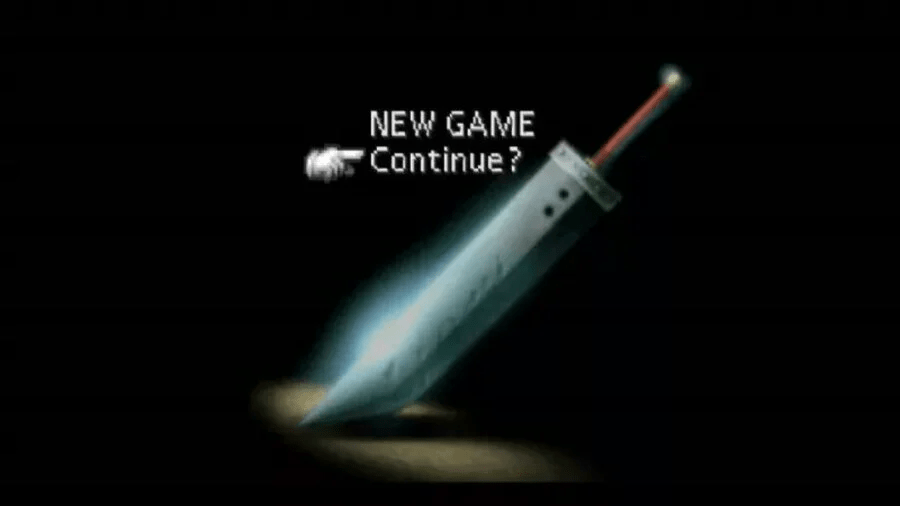
Before the game begins, we have a title sequence opening like a movie would. We see all these names behind what we’re about to play…but why? If you don’t want to read all the credits of the people, you press X and are then taken to a nearly all-black screen with the iconic Buster Sword in the middle, wedged into stone as if it has been used for the final time.
What’s so great about this opening is that it tells us all about the cinematic gaming experience we’re about to have. Nothing like Final Fantasy VII had happened to that point, so to see a game begin with a long line of credits showing the amount of people behind this masterpiece was just different, but in a great way.
Uematsu’s score provides us a magical comfort but with a mystery to what we’re going to experience. Then, before we play the game, we see the Buster Sword as if it’s our last bastion of calm before we delve into the world of the evil Shinra Corporation, SOLDIERs, the mysterious Mako substance, and gaming’s greatest villain: Sephiroth.
After you hit “New Game,” the iconic opening continues with the Bombing Mission score beginning softly as we’re introduced to Aerith, the vast city of Midgar, and our hero–Cloud–as he leaps off a train and poses on the Sector 8 train platform. The rest was history.
This game itself was legendary enough to get the modern touch to it. 2020’s Final Fantasy VII: Remake was an amazing retelling of the classic story with modern updates and graphics. But, how can you remake an opening that had so much meaning behind it?
Well, you can’t.
Final Fantasy VII: Remake‘s title screen is identical. Remastered Prelude, remastered Buster Sword, but the emotion and imagery are the same.
Once you hit “New Game” on Remake, the iconic opening is redone beautifully, with some added scenes to show that this updated Midgar, and outer world of Gaia, is sprawling with life.
Enjoy some of Uematsu’s best before I wrap this thing up:
There are many more games that have similar openings or ones that also convey the perfect audio visual embodiment of what you’re about to play. But these four are some of my favorite games of all-time because their title screens and opening scenes still send chills down my spine.
Every playthrough of each game, I pause at the title screen for a second to take in the beauty of each. The journeys taken in each of these games all began with beautiful title screens, beautiful music, and iconic openings.
As I said above, there are many ways to begin things. But in my eyes, there’s only one perfect way to begin a video game and these four games did that.
Did I miss any of your favorites? Let me know why!


 The Danny Diaries